




Jib vs Luffing Cylinder: Key Differences | Newstar
Both the jib cylinder and the luffing cylinder are hydraulic actuators used in aerial work platforms, but they control different boom motions. The jib cylinder actuates the jib linkage for local articulation and positioning, while the luffing cylinder changes the main boom elevation angle to raise or lower the boom. Their mounting geometry, required force, stroke, load conditions, and operating characteristics differ, so the two cylinders are engineered for different functions rather than treated as interchangeable actuators.
At Newstar, we specialize in the R&D and manufacturing of hydraulic cylinders, servo cylinders, and various non-standard equipment. Our products are widely used in construction machinery, aerial work platforms, shipbuilding and heavy industry, mining, and aerospace. Understanding the function of each actuator is essential for specifying an appropriate hydraulic solution.
Why Aerial Work Platforms Need Different Hydraulic Cylinders
A boom lift relies on multiple hydraulic functions during a typical operating cycle. Depending on the machine configuration, the hydraulic system may raise the main boom and extend telescopic boom sections to increase horizontal outreach. It may also control jib articulation, platform leveling, and, where fitted, outrigger or stabilizer deployment. Each function has different requirements for cylinder force, stroke, operating speed, load holding, and control. Mounting geometry, load path, hydraulic circuit design, and control requirements also vary.
The jib cylinder actuates the jib linkage. Meanwhile, the luffing cylinder controls main-boom elevation by changing the boom angle. Because of this, engineers must pair every cylinder with its specific mechanical role. They cannot simply choose a part based on its size or pressure rating alone.
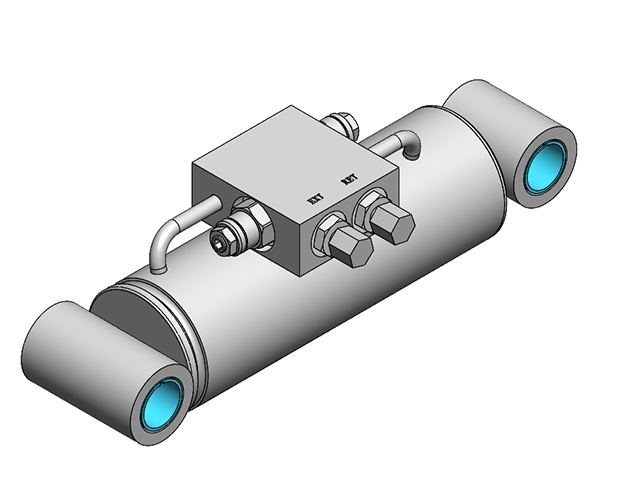
What Is a JIB Cylinder?
The jib cylinder is installed around the jib/arm-frame joint and provides hydraulic actuation for jib elevation or articulation. Its exact motion depends on the boom and linkage configuration of the aerial work platform. Newstar’s available specification range includes a 60–90 mm bore, 25–50 mm rod diameter, 270–700 mm length, 21 MPa operating pressure, and maximum thrust up to 13 T.
JIB Cylinder Function in Boom Positioning
The jib is commonly used for final positioning near the work area. The jib cylinder controls jib articulation near the platform end of the boom when approaching a façade, passing around an obstacle, or reaching a restricted elevated position.
Newstar’s jib cylinder offers reliable performance, wide applicability and convenient installation and maintenance. It is suitable for both telescopic boom lifts and articulated boom lifts.
For an OEM, this means jib cylinder selection should consider more than the required cylinder force. Available installation space, linkage geometry, required articulation angle, mounting points, and the required final working position all influence how the cylinder should be specified.
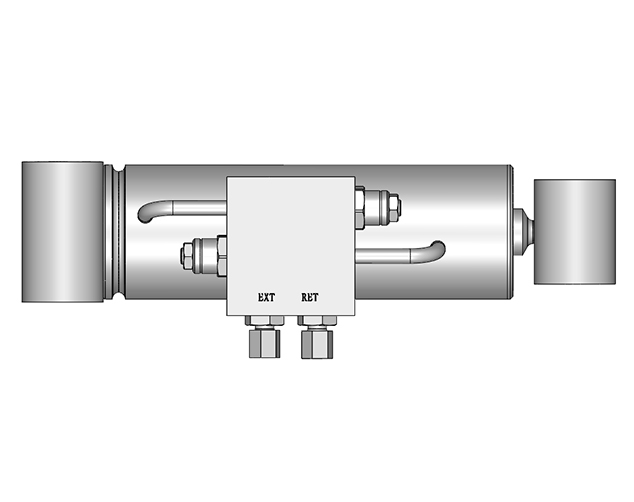
What Is a Luffing Cylinder?
The luffing cylinder performs the primary boom-elevation function. In an aerial work platform, it is normally installed at the hinge between the main boom and the turntable or undercarriage, or at a hinge point in a folding-boom structure.
As the cylinder extends or retracts, it changes the angle between the boom and the horizontal plane. This drives the boom upward or downward and directly influences the working height and working radius of the platform.
Newstar’s Luffing Cylinder range covers bore diameters of 40–230 mm, rod diameters of 25–180 mm, strokes of 500–3000 mm, and overall lengths of 700–3800 mm. Working-pressure data extends up to 30 MPa, while maximum thrust can reach 120 T depending on the cylinder configuration.
Why Luffing Cylinder Loads Can Be High
A hydraulic luffing cylinder works against the boom structure and the load transmitted through it. Required force changes with boom length, pivot position, mounting points, operating angle, center of gravity, and platform load.
For this reason, maximum thrust is only one selection factor. Newstar’s luffing cylinder combines a compact structure with high load capacity, smooth operation, high control accuracy, broad adaptability, and convenient maintenance.
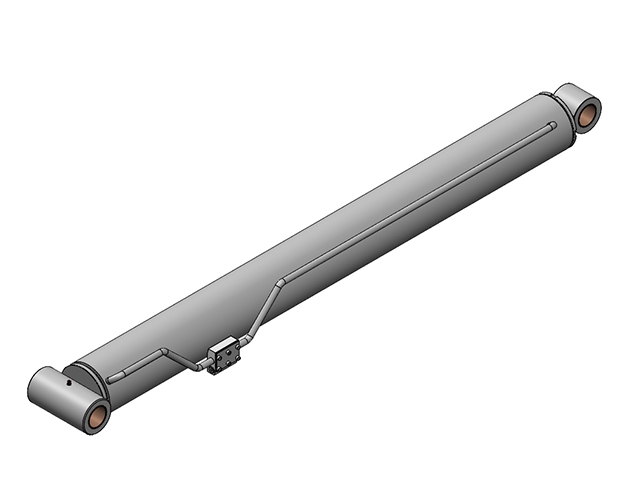
Jib Cylinder vs Luffing Cylinder: Key Differences
|
Comparison Point |
JIB Cylinder |
Luffing Cylinder |
|
Main Function |
Jib articulation and local positioning |
Main boom elevation |
|
Bore Range |
60–90 mm |
40–230 mm |
|
Rod Diameter |
25–50 mm |
25–180 mm |
|
Stroke |
90-500mm |
500–3000 mm |
|
Length |
270–700 mm |
700–3800 mm |
|
Working Pressure |
21 MPa |
17–30 MPa |
|
Maximum Thrust |
Up to 13 T |
Up to 120 T |
The comparison shows why these two aerial work platform hydraulic cylinders are not interchangeable. Even when their external appearance is similar, force capacity, dimensions, mounting arrangement, and load path may be designed for very different tasks.
How Jib and Luffing Cylinders Work Together
The luffing cylinder changes the main boom angle to establish the required working height. Where telescopic boom sections are fitted, an extension cylinder adjusts horizontal outreach, while the jib cylinder provides additional articulation near the platform.
Cylinder specification should therefore reflect the complete machine. Bore, rod diameter, stroke, installation length, pin locations, boom angle, system pressure, load, and duty cycle should be reviewed together.
This is particularly important for articulated boom lifts, where several joints may operate through one working sequence. Correctly matching each hydraulic cylinder to its individual motion supports smooth, coordinated, and stable hydraulic motion control throughout the boom operating envelope.
What OEMs Should Check Before Specifying a Cylinder
For a new aerial work platform or replacement project, start with machine drawings and operating conditions. Confirm stroke, retracted and extended length, mounting dimensions, maximum load, pressure, movement speed, working angle, and available installation space.
Outdoor equipment may also face moisture, dust, repeated cycling, and corrosion. At Newstar, we use imported Parker/Simrit seals and proprietary high-corrosion, crack-free chrome plating. According to our product information, the plating is SGS-verified with hardness of at least 950 HV and more than 500 hours of salt-spray resistance.
Testing is equally important. Newstar’s intelligent test station uses servo motors and sensors with closed-loop control to test breakaway pressure, stroke, internal leakage, external leakage, and proof pressure. The system provides pressure-control precision within 0.5%.
Why Work with Newstar for Aerial Platform Cylinders?
At Newstar, we combine engineering, machining, assembly, surface treatment, and testing. Our resources include automatic assembly lines, friction welding, intelligent plating, pressure-testing facilities, and an R&D team supporting customized solutions.
Boom-lift cylinders are typically application-specific, with bore, stroke, mounting geometry, and force requirements defined around the machine architecture.
For OEM projects, our engineering review can focus on required force, mounting geometry, stroke, sealing, corrosion protection, operating environment, and test requirements.
Conclusion
The key difference in jib cylinder vs luffing cylinder selection is the motion each actuator controls. The jib cylinder supports local jib or working-arm positioning, while the luffing cylinder changes main boom elevation and therefore faces different structural and load requirements.
For OEMs, the right boom lift hydraulic cylinder should be specified based on actual boom geometry, load cases, stroke, mounting arrangement, system pressure, operating environment, and duty cycle. At Newstar, we use application-specific engineering, manufacturing, surface treatment, and testing to support reliable hydraulic motion in aerial equipment.
Contact Newstar to discuss a custom jib, luffing, or other hydraulic cylinder solution for your aerial work platform project.
FAQ
Q: What is the main difference between a jib cylinder and a luffing cylinder?
A: A jib cylinder mainly actuates the jib linkage to control jib articulation and positioning, supporting local positioning near the platform. A luffing cylinder controls main boom elevation by changing the boom angle. Their different functions create different requirements for stroke, force, installation geometry, and load capacity.
Q: What information should an OEM provide for a custom boom lift hydraulic cylinder?
A: Useful inputs include bore diameter and rod diameter, stroke, retracted and extended length, mounting dimensions, pin size, system pressure, expected load, boom geometry, working angle, operating speed, environment, and duty cycle. Drawings or an existing cylinder sample can also support engineering review.
Q: How do I choose a jib cylinder or luffing cylinder for a boom lift?
A: Selection should begin with the motion the cylinder needs to control. Engineers should then review required cylinder force, bore diameter, rod diameter, stroke, retracted and extended pin-center dimensions, system pressure, mounting geometry, boom or jib angle, duty cycle, and operating environment. OEM drawings are especially useful when developing a custom hydraulic cylinder.
Previous: None